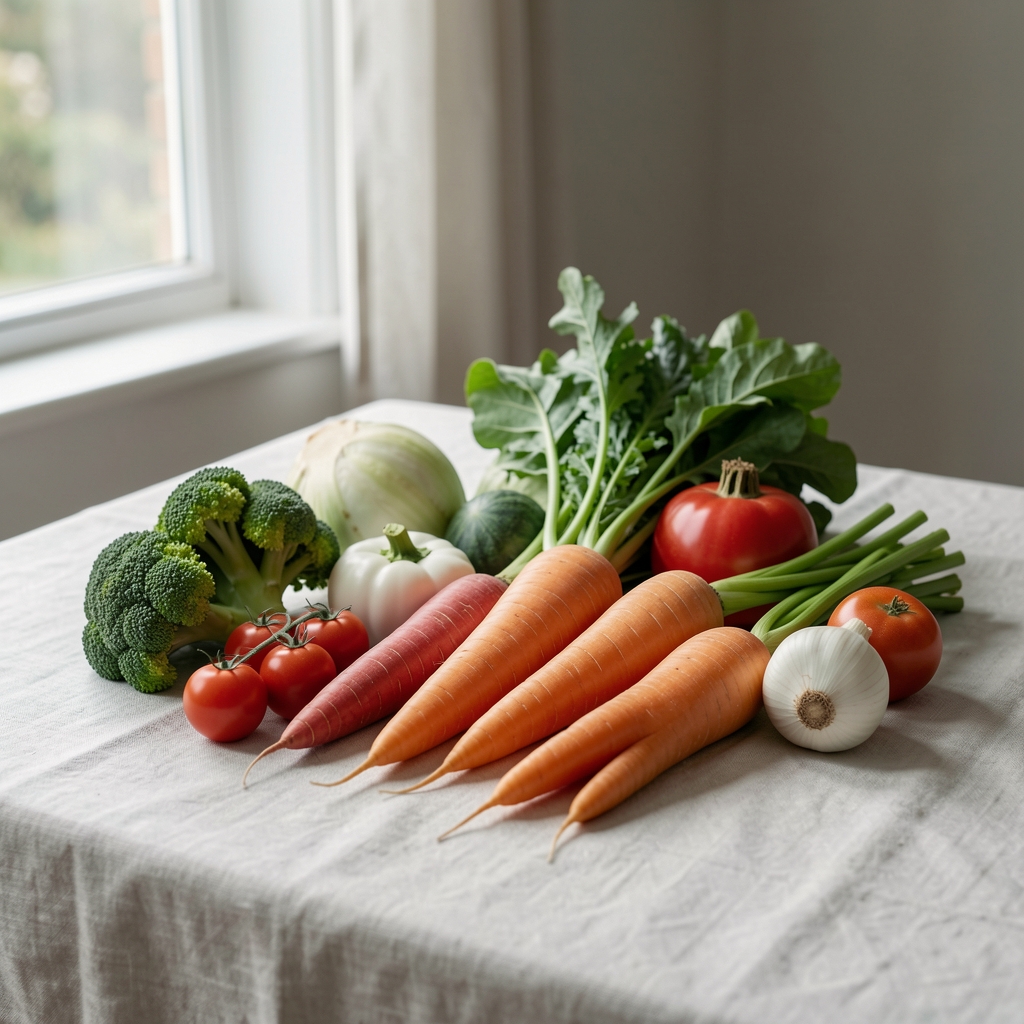
When the produce calendar turns to root vegetables and brassicas, something shifts in the texture of daily eating. The shift is not only culinary — it is structural. The winter plate, composed around celeriac, parsnips, swede, beetroot, kale, and the various forms of cabbage that arrive between November and March, has a different nutritional architecture than its summer counterpart. It is denser, more fibrous, lower in water content, and typically more satisfying per unit of volume. Whether these properties translate into meaningful differences in weight and satiety over the course of a sustained winter season is the question this piece attempts to address.
The Seasonal Plate as a Nutritional Unit
Nutritional discussions of seasonal produce tend to focus on specific nutrient contents — the vitamin C in kale, the beta-carotene in carrots, the resistant starch in cooled potatoes — and then to generalise from these individual properties toward broader claims about seasonal eating. This approach, while not without value, misses something about how seasonal eating actually functions in practice. The seasonal plate is not a collection of individual nutrients. It is a structured unit of food that arrives in a specific context: a particular market, a particular set of cooking habits, a particular rhythm of shopping and preparation.
This piece draws on a twelve-week food journal kept between late November 2025 and mid-February 2026 — a period that corresponds closely to the core of the British winter produce season. The journal was kept with the explicit intention of documenting not just what was eaten, but how the seasonal constraints of the winter market shaped the choices available at each meal. The findings are offered as observation, not as a structured research programme. They are the record of one nutrition professional's sustained engagement with a single season's produce, and should be read in that spirit.
What the Winter Market Provides
The first notable feature of purchasing from a seasonal market in winter is the reduction in variety available at any single visit — paired with an increase in the depth of each category. Summer markets offer a profusion of different vegetables in smaller quantities of each; winter markets offer fewer categories, but in generous abundance. Celeriac, for instance, which occupies a modest corner of the summer market's peripheral stalls, becomes a central presence in winter: large, varied in size, inexpensive per unit, and remarkably versatile in cooking.
This structural change in what is available shapes the cook's repertoire in ways that have downstream nutritional consequences. When celeriac is the predominant bulb available, it appears in the food journal with a frequency that it would never achieve in a summer of abundant courgettes, tomatoes, and salad leaves. It is roasted, mashed, sliced into remoulade, added to soups, and occasionally eaten raw. Each of these preparations has different properties in terms of how the body processes the food and how satiating the resulting meal proves to be.
"The winter market does not restrict — it concentrates. The discipline of seasonal eating is not deprivation; it is a kind of editorial selection imposed by the calendar itself."
Eleanor WhitfieldRoot Vegetables and the Satiety Record
The most consistent observation from the twelve-week journal was this: meals centred on roasted or slow-cooked root vegetables produced a different quality of satiety than meals of equivalent caloric density based on summer salad vegetables or grains. This is not to say they were more filling in a gross volumetric sense — they were not always. It is rather that the satiety they produced seemed more sustained. The interval between meals during which hunger signals were absent was, in the journal record, consistently longer on days when root vegetables formed the primary ingredient of both lunch and dinner.
Dietary fibre is the most obvious candidate for explaining this observation. Root vegetables in general, and celeriac, parsnips, and swede in particular, carry significant quantities of both soluble and insoluble fibre. Soluble fibre, which forms a gel-like substance in the digestive process, is associated in nutritional literature with a prolonged sense of fullness between meals. The food journal cannot establish causation — it can only observe correlation. But the pattern was consistent enough, across twelve weeks and multiple cooking methods, to warrant recording as an observation.

Brassicas and the Question of Variety
A parallel strand of the winter journal concerned the brassica family — kale, cavolo nero, savoy cabbage, Brussels sprouts, purple sprouting broccoli — which runs through the British winter season with an almost choreographed sequence. Each variety arrives and peaks within a specific window, and the cook who shops seasonally moves through them in order rather than selecting freely from a fixed supermarket category.
The nutritional significance of brassicas in a winter eating pattern centres less on any single property and more on their role as the primary source of leafy green in the diet during the months when salad vegetables are either unavailable or prohibitively expensive. The food journal showed a clear correlation between weeks in which brassicas featured prominently in the cooking record and weeks in which overall vegetable variety was highest — not because brassicas are themselves diverse, but because the shopping trip that delivers brassicas also tends to deliver the other seasonal vegetables that accompany them at the winter market.
This finding speaks to one of the less discussed aspects of seasonal produce and weight: the market trip itself as a nutritional intervention. When the journey to the market is made with the intention of cooking from what is available, rather than from a fixed list of desired items, the resulting kitchen tends to contain a wider variety of vegetables than a supermarket shop driven by recipe-based purchasing. Variety, in nutritional practice, is associated with a broader intake of different micronutrients and with a more complex dietary pattern — both of which appear in the nutritional literature as characteristics of eating habits that support weight balance over time.
- 01. Meals centred on roasted root vegetables produced consistently longer satiety intervals than grain-centred meals of comparable caloric density.
- 02. Brassica-rich weeks correlated with higher overall vegetable variety in the week's cooking record.
- 03. Seasonal purchasing from a market, rather than list-driven supermarket shopping, produced a wider range of vegetables in the kitchen across the twelve-week period.
- 04. Winter cooking, which requires longer preparation times, correlated with more attentive eating and smaller portions than quickly assembled meals.
- 05. Weight remained stable across the twelve-week period, with no intentional dietary restriction. The stability is attributed to high dietary fibre, frequent home cooking, and the inherently low caloric density of root vegetables consumed in volume.
The Preparation Time Variable
One dimension of winter eating that the food journal captured unexpectedly was the relationship between preparation time and eating pace. Root vegetables require more preparation than salad vegetables or quick-cook summer produce. Celeriac must be peeled and diced; parsnips and beetroot require roasting time; soups built from winter vegetables need forty minutes or more on the hob. This longer preparation time, the journal suggested, consistently produced a more attentive quality of eating.
The mechanism is not mysterious: a meal that required forty minutes of preparation is eaten with more attention than a meal assembled in five. The cook has already invested time and decision-making in the food before it reaches the table, and that investment changes the experience of eating it. The literature on mindful eating documents this relationship in various forms — the preparation of a meal is itself a form of anticipatory engagement with food that shifts the eater's relationship with what is consumed.
Whether this observation has implications beyond the individual record is a question the journal cannot answer. But as a personal finding, it has persisted across multiple winters of documentation: the plate assembled from ingredients that required care in their preparation is eaten more slowly, with greater attention, and — consistently — in smaller quantities than the plate that was quick to assemble. This is not evidence of anything beyond one food journal. But it is a finding that, in its consistency, seems worth recording.